
Rotor Matrix
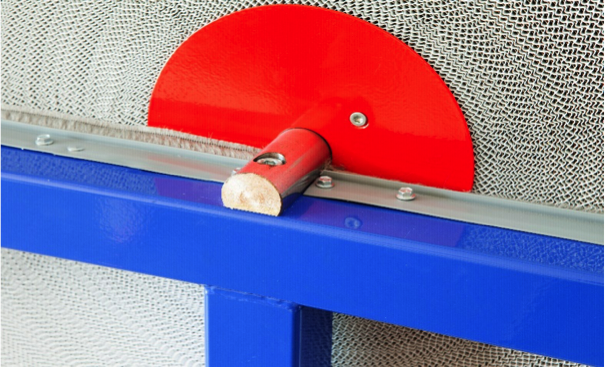
Air speed should be kept low for best efficiency. The stable design allows a pressure drop of 300 Pa across one piece rotors and 400Pa across sectorized rotors. However, these pressure drops are not recommended as high air speeds result in lower efficiency and higher fan energy consumption.
The rotor may be installed vertical or horizontal (vertical is standard; horizontal is an option). One piece rotors up to Ø 2100 mm may be installed horizontally, and sectorized up to Ø3200 mm.
Five different well heights are available to enable optimization of efficiency and pressure drop

| Rotor type | Well height | Well length |
|---|---|---|
| Extra Low (XL) | 1.5 mm | 3.0 mm |
| Special Low (SL) | 1.65mm | 3.0 mm |
| Low (L) | 1.7 mm | 4.0 mm |
| Normal (N) | 2.0 mm | 4.0 mm |
| High (H) | 2.7 mm | 5.5 mm |
Rotor matrix is consist of hub, bearings and foil.
The rotor matrix is made for laminar airflow using alternating layers of flat and corrugated foil to provide a structure comprising small, triangular channels.
The rotors are either one piece or sectorized. Sectorized rotors are divided into segments that are assembled when the rotor is installed. One piece rotors are made in diameters between Ø300–2450 mm, while sectorized rotors have diameters of Ø600-5000 mm.
All rotors are made mechanically stable by internal spokes screwed into a hub and welded around the periphery.
This design allows cleaning with compressed air, steam, hot water or special cleaning agents. (for cleaning agents contact Ostberg).
Temperature range -20°C to +70°C.
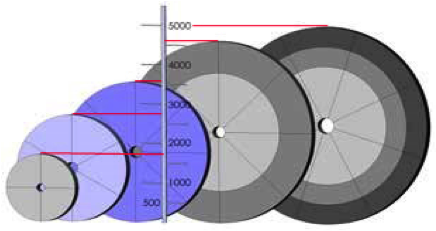
The illustration above shows the number of segments for sectorized rotors of different dimensions.
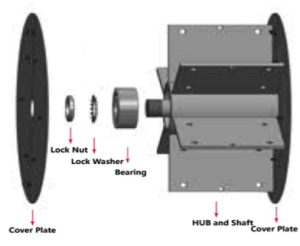
Rotors are made in widths of 250, 200, 150 or 100 mm. as standard in all materials. For large OEM customer a customized width can be provided.Rotors have maintenance-free hubs with life-time lubricated ball or roller bearings in a protected location in the hub. All bearings are sealed to prevent dirt and humidity from entering the bearing.Bearing lifetime is at least 200,000 h for one piece rotors and at least 60,000 h for sectorized rotors in continuous operation with a maximum rotation of 20 rpm (L10h as per ISO 281:19910).
| Vertical installation | Width 100 mm | Width 150 mm | Width 200 mm | Width 250 mm |
|---|---|---|---|---|
| Rotor one piece, Ø (mm) | 300-1500 | – | 300-2450 | 300- 2450 |
| Rotor, sectorized, Ø (mm) | – | – | 950-5000 | – |
| Horizontal installation | Width 100 mm | Width 150 mm | Width 200 mm | Width 250 mm |
|---|---|---|---|---|
| Rotor, one piece, Ø (mm) | 300-1500 | – | 300-2000 | 300-1800 |
| Rotor, sectorized, Ø (mm) | – | – | 950-3200 | – |
Foil type “Media”
Condensation rotors, non-hygroscopic rotors (ST1-O, STC1-O, AK2-O)
The condensation rotor is a cost-efficient solution to recover heat and is suitable for standard applications in comfort ventilation. Humidity is only transferred in cases when the dew point of one of the air streams is reached.
Hygroscopic rotors (STE1-O, SH1-O)
The hydroscopic surface of this rotor class supports humidity transfer. Typically used for standard applications in comfort ventilation systems to recover humidity.
Sorption rotor (HM1-O)
The high performance desiccant coatings of the sorption rotor HM1-O (molecular sieve 3Å) provide a maximum humidity transfer capacity for minimal Carry Over. The high humidity efficiency is constant throughout all climate conditions. Sorption rotors are especially designed for summer season cooling recovery and dehumidification of supply air. Therewith, it should always be used in humid and hot climates, with dry cooling systems (chilled beams) and when in winter time humidifiers are used. This substantially reduces the cooling and humidification demand of the HVAC system
| Type | Condensation | Hygroscopic | Sorption | Remarks |
|---|---|---|---|---|
| ST1-O | x | Untreated aluminium foil | ||
| STE1-O | x | Oxidized aluminium foil | ||
| STC1-O | x | Epoxy-coated foil | ||
| AK2-O | x | Seawater resistant foil (AlMg), 100 µ. | ||
| SH1-O | x | 3Å Molecular sieve and untreated aluminium foil | ||
| HM1-O | x | 3Å Molecular sieve |
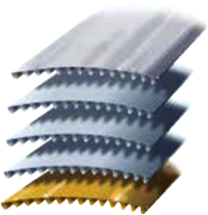
For special applications, other suitable material types are available:
Increased rigidity (AK2-O)
Under extreme strain, for example, applications with automatic cleaning devices using high pressure water in industrial equipment, we suggest a foil thickness of 100 micron.
Increased corrosion protection (STC-O,AK-O)
In an environment with aggressive components in the air it is either recommended to use a rotor with epoxy coating (STC1-O) or a sea water corrosion resistant foil (AK-O) for better corrosion protection. Such applications can be, e.g. dairy industry, on ships or for coastal areas. Other applications for additional corrosion protection are adiabatic cooling and cooling rotors of Direct Evaporative Cooling (DEC) units.